Architecture
This page explains the technical architecture of the character network database and processing pipeline.
System Overview
The Naruto character network system consists of three main layers:
graph TB
    A[Subtitle Files<br/>.ass format] -->|Parse| B[Processing Pipeline<br/>naruto_net package]
    B -->|Extract| C[Intermediate Data<br/>Events, Scenes, Mentions]
    C -->|Build| D[Network Edges<br/>CSV format]
    D -->|Import| E[Neo4j Graph DB<br/>:Character :CONNECTED]
    E -->|Query| F[Network Analysis<br/>Centrality, Communities]
    F -->|Visualize| G[Interactive Viz<br/>D3.js]

    style A fill:#FFF3E0
    style B fill:#E8F5E9
    style C fill:#F3E5F5
    style D fill:#E3F2FD
    style E fill:#FFE0B2
    style F fill:#F1F8E9
    style G fill:#FCE4EC
Neo4j Graph Database Schema
The character network is stored in a Neo4j graph database using a multi-label pattern for arc-specific analysis.
Complete Schema Diagram
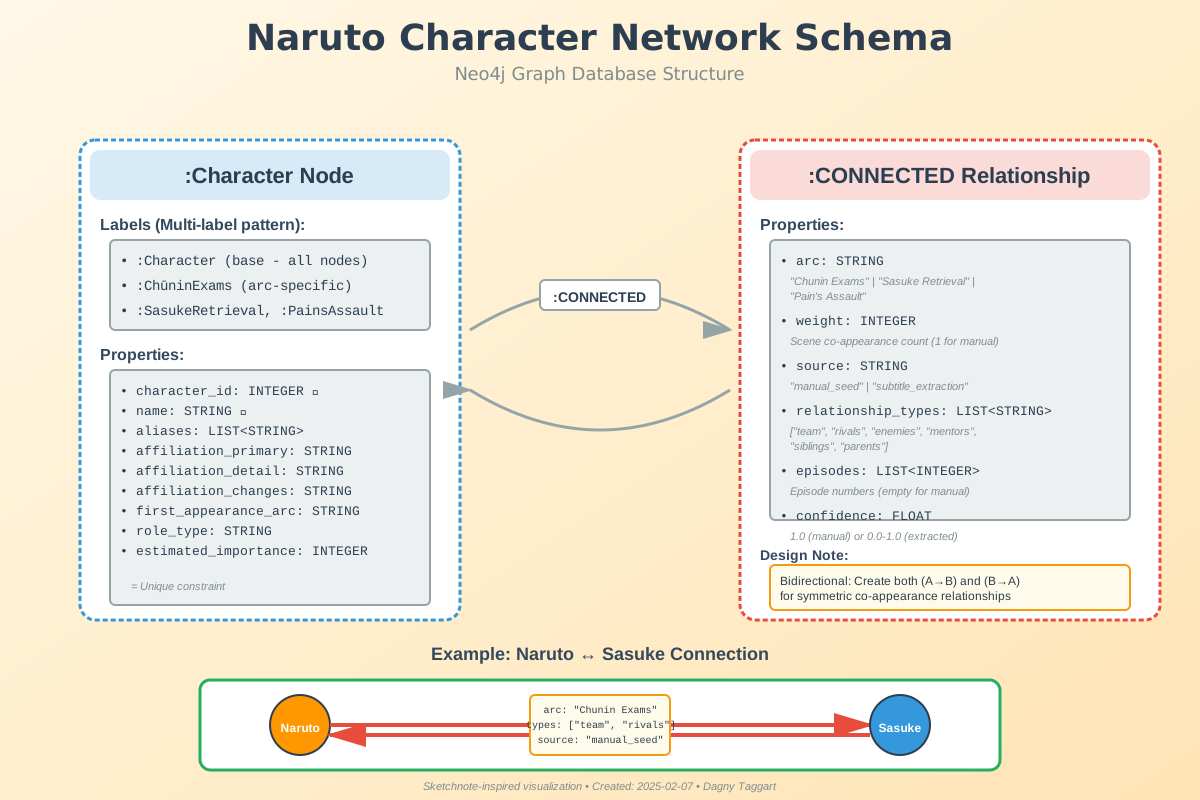
Full schema showing node structure, relationship properties, and example connection
Node Structure: :Character
Every character in the network has the base label :Character plus arc-specific labels.
Multi-Label Pattern
Why multi-labels?
- Simple queries:
MATCH (c:ChūninExams:SasukeRetrieval)finds characters in both arcs - Built-in counting:
size(labels(c)) - 1= number of arcs - More intuitive than separate Arc nodes with relationships
Character Properties
| Property | Type | Description | Indexed |
|---|---|---|---|
character_id |
INTEGER | Unique identifier | ✓ (unique) |
name |
STRING | Canonical name | ✓ (unique) |
aliases |
LIST\<STRING> | Known nicknames/titles | |
affiliation_primary |
STRING | Main village/organization | ✓ |
affiliation_detail |
STRING | Squad/team membership | |
affiliation_changes |
STRING | Defection tracking (e.g., Sasuke) | |
first_appearance_arc |
STRING | Debut arc | |
role_type |
STRING | protagonist/antagonist/supporting | ✓ |
estimated_importance |
INTEGER | 1-10 centrality estimate | ✓ |
Example node:
(:Character:ChūninExams:SasukeRetrieval {
  character_id: 1,
  name: "Naruto Uzumaki",
  aliases: ["Naruto", "Nine-Tails", "Hokage"],
  affiliation_primary: "Konoha",
  affiliation_detail: "Team 7",
  role_type: "protagonist",
  estimated_importance: 10
})
Relationship Structure: :CONNECTED
Characters are connected with a single relationship type that stores semantic information in properties.
Why Single Relationship Type?
Simplicity: Easier to query all connections without UNION clauses
Flexibility: Relationship semantics stored in relationship_types array
Data lineage: source property distinguishes manual vs extracted edges
Relationship Properties
| Property | Type | Description |
|---|---|---|
arc |
STRING | "Chunin Exams" | "Sasuke Retrieval" | "Pain's Assault" |
weight |
INTEGER | Scene co-appearance count (1 for manual seeds) |
source |
STRING | "manual_seed" | "subtitle_extraction" |
relationship_types |
LIST\<STRING> | ["team", "rivals", "enemies", "mentors", "siblings", "parents"] |
episodes |
LIST\<INTEGER> | Episode numbers (empty for manual seeds) |
confidence |
FLOAT | 1.0 for manual, 0.0-1.0 for extracted |
Controlled Vocabulary for relationship_types
team— Same squad/organizationrivals— Competitive relationshipenemies— Active antagonismmentors— Teacher/student dynamicsiblings— Family relationship (blood or found family)parents— Parent/child relationshipco_appearance— Generic co-occurrence (for extracted data)
Example relationship:
(naruto:Character)-[:CONNECTED {
  arc: "Chunin Exams",
  weight: 1,
  source: "manual_seed",
  relationship_types: ["team", "rivals"],
  episodes: [],
  confidence: 1.0
}]->(sasuke:Character)
Bidirectional Creation
For symmetric co-appearance relationships, we create both (A→B) and (B→A) edges. This ensures queries like "MATCH (n:Character)-[:CONNECTED]->(m)" work regardless of edge direction.
Processing Pipeline Architecture
The naruto_net Python package implements a modular pipeline:
Pipeline Stages
graph LR
    A[1. IO<br/>Parse .ass] --> B[2. Normalize<br/>Clean text]
    B --> C[3. Segment<br/>Detect scenes]
    C --> D[4. Detect<br/>Find mentions]
    D --> E[5. Build<br/>Create edges]
    E --> F[6. QC<br/>Validate]

    style A fill:#E3F2FD
    style B fill:#F3E5F5
    style C fill:#FFF3E0
    style D fill:#E8F5E9
    style E fill:#FFE0B2
    style F fill:#FFEBEE
Module Breakdown
1. IO (src/naruto_net/io/)
Purpose: Parse .ass subtitle files into structured events
Key classes:
AssReader— Loads .ass files, extracts dialogue linesSubtitleEvent— Dataclass for (start, end, text) tuples
Output: data/intermediate/events_<episode>.csv
2. Normalize (src/naruto_net/normalize/)
Purpose: Clean ASS formatting tags and split multi-speaker lines
Functions:
strip_ass_tags()— Remove{\i1},{\b1}, etc.normalize_newlines()— Convert\Nto spacesplit_multi_speaker()— Handle "Speaker A: ... Speaker B: ..." lines
Output: data/intermediate/utterances_<episode>.csv
3. Segment (src/naruto_net/segment/)
Purpose: Group utterances into scenes using timing gaps
Logic: If gap between consecutive lines > 3 seconds → scene break
Output: data/intermediate/scenes_<episode>.csv
4. Detect (src/naruto_net/detect/)
Purpose: Find character mentions using alias matching
Method: Word-boundary regex against character_aliases.json
Confidence heuristic:
- Direct name match → 1.0
- Alias match (e.g., "Pervy Sage" → Jiraiya) → 0.8
- Honorific only (e.g., "Hokage") → 0.5
Output: data/intermediate/mentions_<episode>.csv
5. Build (src/naruto_net/build/)
Purpose: Construct co-appearance edges from scene presence
Logic:
For each scene:
- Collect all characters mentioned
- Create edge between every pair (with weight = 1)
- If pair appears in multiple scenes, increment weight
Output: data/processed/edges.csv
6. QC (src/naruto_net/qc/)
Purpose: Generate quality control reports
Reports:
- Episode QC: Events parsed, scenes created, characters detected per episode
- Alias QC: Which aliases matched most frequently, any shadowing issues
Output: data/reports/episode_qc.csv, data/reports/alias_qc.csv
Data Flow Example
See the How It Works page for a detailed walkthrough of Episode 154 processing.
Directory Structure
naruto-network-graph/
├── src/naruto_net/          # Python package (pip install -e .)
│   ├── io/                  # .ass parsing
│   ├── normalize/           # Text cleaning
│   ├── segment/             # Scene detection
│   ├── detect/              # Character mention matching
│   ├── build/               # Edge construction
│   └── qc/                  # Quality control reports
├── data/
│   ├── intermediate/        # Pipeline outputs (gitignored)
│   ├── processed/           # Final edges.csv, scene_character.csv
│   ├── reports/             # QC reports (gitignored)
│   └── *.csv                # Character metadata, canonical edges
├── outputs/
│   ├── cypher_import_characters.cypher  # Neo4j import (87 chars)
│   ├── cypher_import_edges.cypher       # Neo4j import (36 edges)
│   └── analytical_queries.cypher        # 7 validation queries
├── scripts/
│   ├── 00_ass_ingest_subset.py          # End-to-end pipeline runner
│   ├── import_characters_to_neo4j.py    # Generate Cypher for chars
│   └── import_test_edges.py             # Generate Cypher for edges
└── tests/                   # 4 test suites with fixtures
Design Decisions
Why Neo4j?
Graph-native storage: Network queries (shortest path, centrality, community detection) are first-class operations
Cypher expressiveness: Queries like "find all paths between Pain and Konoha characters" are concise
Visualization: Built-in Neo4j Browser for quick exploration
Flexibility: Can mix structured properties with graph traversals
Why Subtitle Files?
Precision: Subtitle timing provides frame-accurate scene boundaries
Availability: Fansub .ass files widely available for popular anime
Speaker proxy: Character mentions in dialogue ≈ character presence in scene
Reproducibility: Subtitle files are the source of truth, not manual annotation
Why Multi-Label Pattern?
Query simplicity: MATCH (c:ChūninExams) is cleaner than MATCH (c)-[:APPEARS_IN]->(:Arc {name: "Chunin Exams"})
Storage efficiency: No need for separate Arc nodes
Built-in arc counting: labels(c) gives immediate arc participation
Tradeoff: Less flexible for many arcs (would become unwieldy for 100+ arcs), but perfect for our 3-arc scope
Performance Considerations
Current Scale
- 87 unique characters
- 150 character-arc records (87 chars × avg 1.7 arcs each)
- 36 manual edges (72 bidirectional)
- ~500 subtitle files across 3 arcs
Expected Scale (Full Pipeline)
- ~1,200 scenes per arc (30 episodes × 40 scenes/episode)
- ~10,000 edges per arc (estimated)
- Query time: <100ms for typical centrality queries
Optimization Notes
- Indexes on:
character_id,name,affiliation_primary,role_type,estimated_importance - Cypher hints: Use
USING INDEXfor large traversals - Batch imports: Use
UNWINDfor bulk edge creation (seecypher_import_edges.cypher)
Next Steps
- How It Works — See the pipeline in action
- API Reference — Explore the
naruto_netpackage - Troubleshooting — Common issues and solutions